By: Contemporary Fencing
/
October 25, 2026
/
12 minutes of reading
Why Our Venetian Redwood Fence Panels Are Different
Written by Dominic, Director & Fencing Nerd at Contemporary Fencing
This article is based on years of developing and manufacturing Venetian Redwood fence panels in our Kent workshop — and probably thinking about fencing in considerably more detail than is strictly necessary.
There are lots of things we do when making our Venetian fence panels that, once the fence is installed, you’ll probably never notice.
That’s sort of the point.
The grade of timber we use, the way it’s machined, the colour used during pressure treatment, the size of the gaps when we actually make the panels, the nails we use and even which way around we put every individual batten.
Some of these things cost us more. Some make the panels slower to manufacture. And some probably sound slightly obsessive.
But when you put all these little details together, they make a massive difference to how the finished fencing looks.
So, as someone who has probably spent far too much time thinking about slatted fencing, I thought I’d explain why we make our Venetian Redwood fence panels the way we do.
It actually started with Western Red Cedar
When we originally started Contemporary Fencing, Western Red Cedar was what we used to make our slatted fence panels.
And we still love cedar. We still make cedar fencing today.
It has beautiful grain, a lovely natural colour and, when it’s machined with nice crisp square edges, it gives you those really clean horizontal lines that work so well in a contemporary garden.
The problem was the price.
Over the years, the cost of Western Red Cedar went up and up, to the point where it was becoming unaffordable for a lot of people.
We wanted to come up with an alternative.
But we didn’t want to make a cheap version of our cedar fencing.
That’s quite an important distinction.
What we wanted to do was find a more affordable timber and then make the fence in exactly the same way we made our cedar panels.
In other words, change the timber, not the standard of the fencing.
Picture below – Western Red Cedar Slatted Fence Panels

Finding the right Redwood wasn’t easy
We looked at a lot of timber.
And I mean a lot.
Different suppliers, different grades, different machining, different treatments. We went through sample after sample trying to find Redwood that would give us the finish we wanted.
Eventually, we developed a very tight specification.
The Redwood we use is high-grade Scandinavian Redwood. We specify joinery-quality timber machined from sideboards, which give us the lovely grain we want across the face of the battens.
This isn’t standard fencing timber that we buy and then turn into a nicer fence panel.
The timber itself is specified for the panel we want to make.
And even that wasn’t enough.
Why do our Redwood battens have square corners?
This probably sounds like a ridiculously small detail.
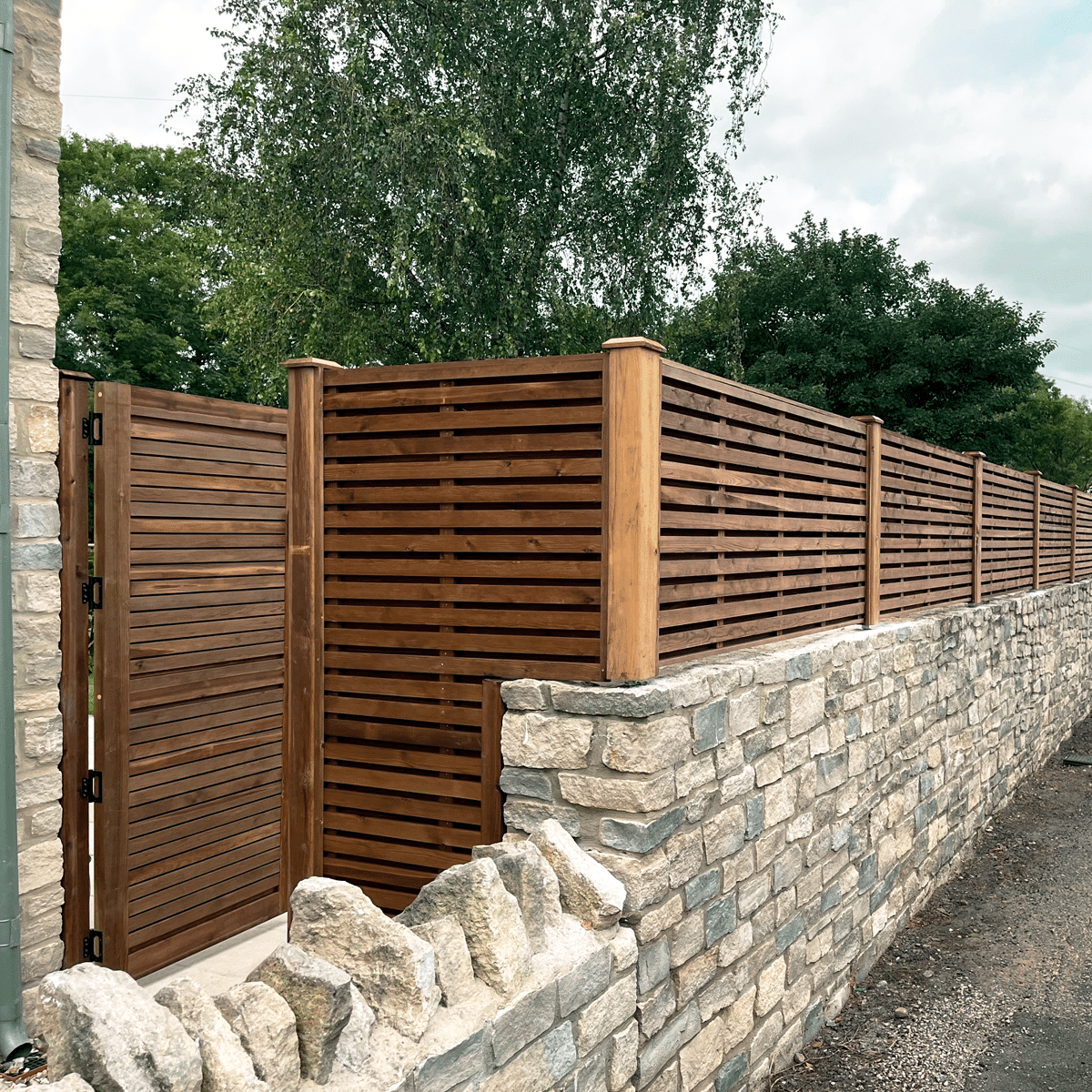
But look closely at our Venetian Redwood fencing and you’ll notice that the battens have really crisp, square corners.
That’s deliberate.
A lot of treated fencing timber has rounded or eased edges. There’s nothing necessarily wrong with that, but I think it creates a completely different look.
Our original cedar panels had square-edged battens and we wanted our Redwood slatted fencing to have the same clean appearance.
When you put dozens of horizontal battens together, those little square edges create really crisp shadow lines between them.
So yes, even the shape of the corner of a 44 x 16mm piece of timber was something we thought about.
I did warn you I was a fencing nerd.
Picture Below – Venetian Redwood Fence Panels

We didn’t want green pressure-treated timber
Then we had another problem.
Pressure-treated fencing timber is traditionally associated with that familiar green colour.
We were trying to make a more affordable alternative to cedar. The last thing we wanted was for it to suddenly look like ordinary green fencing timber.
So the pressure-treatment process became part of our specification as well.
We found a treatment that allows a specially selected colour to be applied during the pressure-treatment process, giving the Redwood a much warmer colour that’s far closer to the appearance we wanted.
So even the colour of the treatment wasn’t an afterthought.
We knew what we wanted the finished Venetian fencing to look like and worked backwards from there.
Every batten has a best side
This is one of my favourite details because it explains why making the panels by hand still matters.
Timber is a natural material. No two pieces are exactly the same.
Both faces of our Redwood battens are clean and planed, but if you pick one up and look at both sides, there’s normally one that looks better.
One side might have particularly nice grain. The other might have a tiny knot. Sometimes there’s nothing actually wrong with either side — one just looks nicer.
Our panel makers are trained to look at every single batten before it goes into the panel.
They turn it over, look at both faces and put the best-looking face forwards.
Exactly the same thing happens when we make our cedar panels.
If you do that with one batten, it makes virtually no difference.
Do it with every batten in a panel, and then every panel in a complete run of fencing, and suddenly it makes a big difference.
A lot of fencing can be manufactured very efficiently using automated panel-making machinery.
We do things slightly differently.
We use precision-made jigs where we want accuracy, but there’s still an experienced person picking up the timber, looking at it and deciding how it should go into the fence.
The jig knows where the batten needs to go. The person making the panel knows which side you want to look at.
I think you need both. Here is Aaron, panel production team leader at Contemporary Fencing.

Our 7mm gap doesn’t actually start at 7mm
Now we’re getting properly nerdy.
Our most popular Venetian fence panels have a 7mm gap between the battens.
Except when we make them, the gap isn’t 7mm.
It’s approximately 5mm.
There’s a very good reason for that.
When Redwood goes through pressure treatment, it absorbs moisture. That causes the timber to swell slightly.
As the fencing dries after manufacture and the treatment moisture leaves the timber, the battens gradually move back towards their original dimensions.
So if we made a freshly treated fence panel with a 7mm gap, once the timber dried that gap could potentially end up nearer 9mm.
We don’t want a 9mm gap.
We want a 7mm gap.
So we allow for what we know the timber is going to do.
Our jigs for a 7mm-gap panel are therefore designed to give us a smaller gap when the freshly treated timber goes into them. As the timber dries and settles, the gap moves towards the 7mm it was designed to be.
It’s a tiny thing, but it sums up our approach quite well.
We’re not just thinking about what a slatted fence panel looks like when it leaves our workshop.
We’re thinking about what it’s going to look like once it’s been installed and the timber has settled.
CNC-made jigs keep everything consistent
Of course, allowing for that movement is fairly pointless if your spacing isn’t accurate in the first place.
That’s why we use CNC-made jigs to manufacture our Venetian fence panels.
They control the position of the battens and keep the spacing consistent across the panel.
Again, though, the jig doesn’t replace the person making the fence.
The jig determines where the batten goes.
The panel maker determines which face you see.
It’s that combination of precision and human judgement that works for us.

Why do we cut a panel that’s already the right size?
This is another slightly strange thing we do.
The timber originally starts at the correct length for the panel.
So you might reasonably ask why, once we’ve made the panel, we get a rail saw out and cut the ends again.
Pressure treatment is part of the reason.
When timber absorbs the treatment it can increase slightly in both width and length. And because timber is a natural material, different battens can absorb slightly different amounts.
That means a stack of battens that originally started at exactly the same length can come back from treatment with slight differences between them.
The obvious answer would be to cut every individual batten to its finished size before making the panel.
We deliberately don’t do that.
If someone is repetitively cutting large numbers of battens against a stop, it only takes one batten not to be pushed completely against that stop before it’s cut.
Then it’s too short.
And there’s not much you can do with a batten that’s too short.
So instead, we make the whole fence panel first.
Once it’s assembled, we use a rail saw to make a final precision cut across the complete panel.
That leaves us with an exceptionally clean, straight and square edge.
When several slatted fence panels are installed next to one another, that matters. The panels meet neatly and those horizontal lines can continue cleanly through the run.
It’s an extra process, but the result is better.

We use stainless steel nails – even though they cost us three times as much
This is another one I get asked about.
Our Redwood fence panels are made in the same workshop as our Western Red Cedar panels.
They’re made by the same people.
They’re made on the same jigs.
And we use the same type of nails.
Stainless steel.
Why use expensive stainless steel nails in pressure-treated Redwood when we could use much cheaper galvanised ones?
Because I want the fence to last.
I’ve seen fencing made with galvanised fixings where, four or five years down the line, you start seeing corrosion around the nails.
You can then get rust staining around the fixing as well.
And imagine that five years from now you decide you want to paint your fencing. The last thing you want is rust marks coming through around all the nails.
Stainless steel nails cost us considerably more, but the nail is going to sit inside that panel for its entire life.
Of all the places to save a few pounds, that doesn’t seem like a particularly clever one.
So we use stainless steel.
The Redwood is more affordable than cedar. The manufacturing standard isn’t.

Made alongside our cedar fencing
Perhaps the simplest way of explaining our Venetian Redwood fencing is this:
We still make cedar fencing.
The Redwood panels haven’t replaced it.
Walk into our workshop and our Western Red Cedar and Venetian Redwood slatted fence panels are being made by the same team, using the same jigs and the same manufacturing principles.
That’s important because when we developed Venetian Redwood, we weren’t trying to create a lower-specification range.
We were basically asking:
Can we find a more affordable timber and use it to make fencing in the way we already know works?
The answer turned out to be yes.
But only if we were very particular about the timber, the machining, the treatment and how we made the panels.

From a cedar alternative to our most popular fence panel
When we launched Venetian Redwood, we really didn’t know quite how popular it would become.
Today, it’s our most popular fencing product.
A lot of our Venetian fence panels are bought by professional landscapers and garden designers for their projects.
And one of the things I’m most proud of isn’t necessarily someone buying them for the first time.
It’s when they come back.
Garden designers and landscapers handle different fencing products and materials all the time. They install the panels. They see how they go together. And ultimately they see what they look like as part of a finished garden.
We find that once someone has used our Venetian Redwood fencing and seen the quality for themselves, they very often come back and use it again on another project.
For me, that’s probably the best endorsement we can get.
And it’s why we keep doing all those little things that most people will never notice.
The grade of Redwood.
The sideboard grain.
The square corners.
The colour of the pressure treatment.
Looking at both sides of every batten.
The 5mm manufacturing gap that eventually becomes the 7mm gap we actually want.
The CNC jigs.
Cutting the finished panel perfectly square.
And using stainless steel nails when cheaper ones would probably do the job for a while.
Individually, none of these things sounds particularly revolutionary.
Together, they’re what make the panel what it is.
We developed Venetian Redwood because we wanted to make a more affordable alternative to Western Red Cedar without abandoning everything we’d learned from making cedar fencing.
The timber changed, The way we believe a garden fence should be made didn’t.
Interesting in finding out more?
If you’re considering Venetian Redwood fencing for your garden or your next landscaping project, you can contact us for free advice. To see our panels – use this link – Venetian Fence Panels


Written by : Contemporary Fencing
Contemporary Fencing is a manufacturer and retailer of high quality garden joinery products including our patented Cequence Fencing System which takes the hard work out of having a slatted fence, the panels are ready- made in handy sizes that will fit perfectly together giving you a high quality finish every time.
Latest articles

September 1, 2026
June 3, 2026
May 6, 2025


Useful links