By: Contemporary Fencing
/
June 3, 2026
/
9 minutes of reading
How to Install Fencing on Top of a Wall
(A Complete Guide)
Adding fencing on top of a wall is one of the most effective ways to increase privacy, security, and visual appeal without completely rebuilding your boundary.
Whether you're working with an existing brick wall, concrete base, or retaining wall, this guide will walk you through why wall-top fencing works so well, what to consider before installing it, also how to do it properly.
Please note: this guide is for fitting fencing on top of a wall, so the posts are actually on top. For fixing panels or posts against the side of a wall this guide is not for you. I do recommend that you still read this as there are many top tips within this post that may save you time.
Why install fencing on top of a wall?
Wall top fencing is a practical solution when you already have a solid boundary but need additional height or screening. The main reason people may need this is additional privacy or increased security. Some wall top fences are just practical but its also possible to have a beautiful looking one that adds style to space.
1. Increase Privacy Without Rebuilding
If your existing wall is too low to block to people looking in, adding fencing above it allows you to gain height without the cost and disruption of replacing the entire structure. Building the wall higher is always an option but it can be very costly and matching the existing bricks with new ones can be hard. So putting a fence on top of the wall can be a better and more cost effective choice.
2. Improve Security
A higher boundary increases security and helps protect your home from intruders. Having a tall wall & fence combination can make it really hard for people to try and climb over. Just the look of a tall boundary is enough to put off anyone with bad intentions.
3. Maintain a Clean, Modern Look
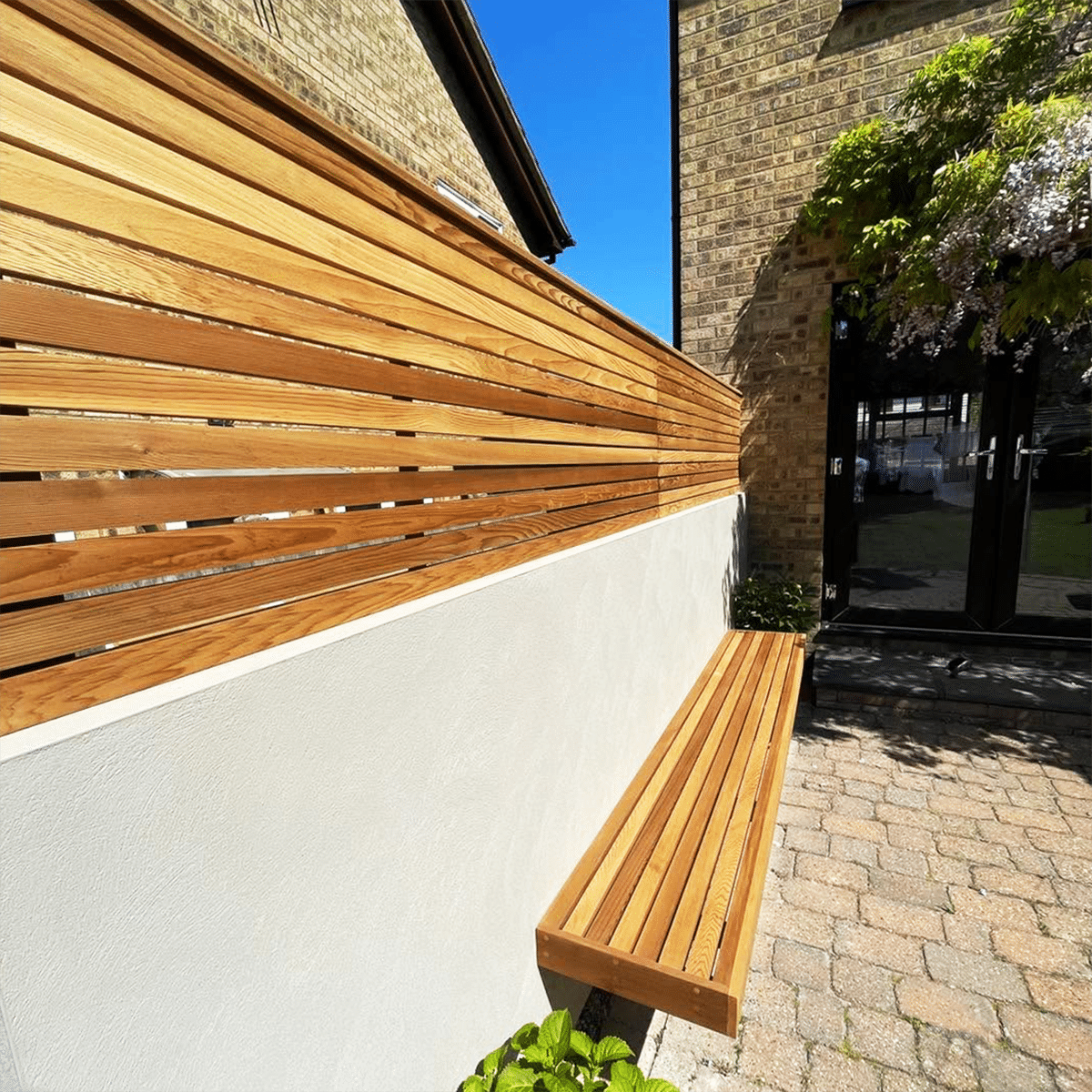
Combining masonry with timber fencing creates a balanced and clean look. Especially when horizontal slats or minimalist designs are used. Slatted fencing on top of walls also has the benefit that it allows some light through if you go for an open slatted option.
4. Maximise Existing Structure
You're effectively building on top of what you already have, which can be more cost-effective and less labour-intensive than starting from scratch.
The fence can step up and slope to suit your wall. Fencing can be cut be installed on a coping or brick on edge.

Is Your Wall Suitable for Fencing?
Before we get too carried away, it's essential to assess whether your wall can safely support additional weight and wind load.
Key things to check:
Wall condition – No major cracks, leaning, or loose masonry
Wall thickness – Ideally at least two bricks thick or 150mm if its a rendered wall.
- Top of wall finish – The wall may have a coping or tile on top. It this happens you may need to drill fixings through. This can be done with a core drill bit.
Height and exposure – The higher and more exposed the area, the greater the wind load. Tall walls in windy areas should be extended further with caution. Proper consideration to the type of post bracket to support the fence is important.
If in doubt, it's worth consulting a professional—especially for taller installations.

Choosing The Right Type of Fence
Not all fencing works well on top of a wall. The key is balancing strength, weight, and wind resistance. For taller walls having an open slatted fence allows light into the garden while still providing privacy. Having open slats also reduce wind loading. If the wall is lower you may want a panel with less gaps.
Venetian Slatted Panels (Popular Choice)
Allow airflow (reduces wind pressure)
Offer privacy without feeling heavy
Clean, modern look
- Easy to install
- Available in a range of woods to suit all budgets

Solid Panels
Maximum privacy
- Cheaper – Closeboard fencing is quite inexpensive.
Higher wind resistance (requires stronger fixing)
- Cons – Closeboard fencing is much heavier so posts need to be fixed with brackets. There are some solid panels that are made from Cedar that offer complete privacy and are much lighter.
Decorative Screens
Ideal for a visual feature, like a backdrop to planting
- Available in composite or metal finishes
Less suitable where privacy is the main goal
- Available in many styles and patterns
How to Fit Fence Posts On Top Of Wall
This is the most critical part. Poor fixing of a wall top fence leads to movement, instability, and eventual failure.
Option 1: Bolt-Down Post Brackets
These are metal brackets that fix directly into the top of the wall.
There are lots of different types available to suit different sized fence posts. Some have a hole to slot the post into and others have a metal plate the is inserted into the bottom of the post. Choosing a bracket that looks nice but also provides enough support can be challenging.
Tip from Dom our Director – Often timber you buy is not the exact size advertised. A 100mm post may actually be 95mm because suppliers often quote the size before processing. This can be troublesome if you have ordered brackets for a larger size and your posts are smaller than expected. Posts sometimes go through a process called regularising which make the post a more consistent size. The supplier often quotes for 4 x 4 posts or 100mm x 100mm but if regularised or planed they will be more like 95mm x 95mm. So Always carefully check with the post supplier and ask – "What is the finished size of the posts?" You can then buy the correct size bracket you need.
Best for:
Brick or concrete walls in good condition
- Make sure the bracket is the correct size for your fence post
Heavier fencing like closeboard or featheredge
- Some brackets are bulky and not nice to look at – so they are not the best looking option
- Taller fencing – extra strong brackets can ensure posts are securely fixed
Installing Post Shoes
Mark post positions evenly – Top tip – cut a few battens to the same width as your fence panel these can be placed on top of the wall so you can easily work out the best post positions
If using brackets set them out along the wall before doing any fixing. This allows you to make sure that it works as expected.
- Once you are happy with the spacings, drill through the holes in your bracket into the wall and fix the bracket to the wall with suitable plugs and screws.
You can now fit your first post, bolt this into the bracket
- If you have accurately set out the bracket positions its safe to now fit the last bracket in the run and install that post
- Now a string line can be set up to make sure the rest are installed perfectly in line.
- Top tip put the line at the rear of the posts so it does not get in the way of the panels.
- Now you can work you way along the fence installing the panels and posts following the line.
Option 2: Specialist Top of wall Posts
Top of wall posts are a timber post that has a metal rod inserted into the bottom. This threaded rod protrudes from the bottom of the post allowing it to be fitted directly into the wall.
Best for:
Brick or concrete walls in good condition
Fences less than 120cm in height ( its possible to go to 150cm height in some circumstances if posts are fitted every 90cm)
- Slatted fencing and trellis
- Faster installations with no visible brackets
Installation basics:
Mark the post positions to check you are happy with the layout.
Starting with the first post. Drill the first hole into the wall using a 28mm core bit or 26mm Masonry bit, blow out the dust. Top Tip – Wear protective eye wear blowing out the dust!
- Do the same with the last post in the fence run.
- Fit the two posts in place using two part resin ensuring they are centred on the wall as you want them. Ensure the hole is filled with resin, Top Tip – Gently rotate the post back and forth as you push the bar into the wall to prevent the resin from popping out. This helps release trapped air.
Once the resin has hardened and the posts are secure set up a string line on the back of the fence posts.
- Next attach the first panel with screws not fully inserted, this is just temporary to get the next post position.
- You can now see the exact position of the next post, the panel can be left attached just move it aside slightly while you drill the next hole.
- Drill the next hole and insert the post with no resin attach the panel to this post.
- Now you can work you way along the fence dry installing the panels and posts following the line.
10. Once the fence has been dry fitted and you are happy with the position, you can start putting two part resin in the holes to fix the posts.
11. So remove the first panel and lift out the post and fill the hole with resin to the top.
12. Then work your way down one panel at a time. This keeps all the panel and posts in the correct position
13. The reason we dry fit is that resin goes off very quickly and it would end up going hard in the nozzle. So having everything ready saves a lot of resin!
Where to buy top of wall fencing
For an easy top of wall option our fence on top of a wall bundle has everything you need to create the perfect wall top fence. Available in three types of wood to suit all budgets. If posts on top of wall wont work for you check out our other wall fencing solutions.
Fence on top of wall panel post and capping bundles available in redwood, cedar and pressure treated timber finishes.


Written by : Contemporary Fencing
Contemporary Fencing is a manufacturer and retailer of high quality garden joinery products including our patented Cequence Fencing System which takes the hard work out of having a slatted fence, the panels are ready- made in handy sizes that will fit perfectly together giving you a high quality finish every time.
Latest articles

September 1, 2026
May 6, 2025
April 7, 2025


Useful links